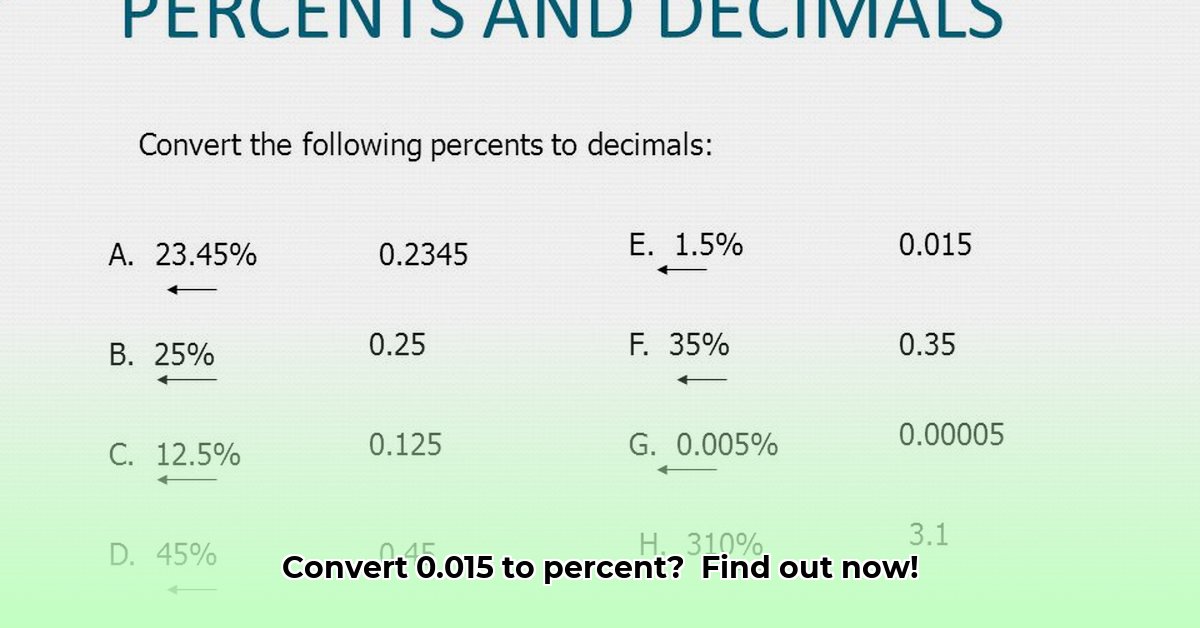
Converting decimals to percentages is a fundamental skill with broad applications, from understanding sales discounts to interpreting financial data. This guide provides a straightforward approach to converting 0.015 to a percentage, along with practical examples and troubleshooting tips.
Method 1: Multiplication by 100
The most common method involves multiplying the decimal by 100. This works because a percentage is a fraction of 100.
- Start with your decimal: 0.015
- Multiply by 100: 0.015 x 100 = 1.5
- Add the percent sign (%): 1.5%
Therefore, 0.015 is equivalent to 1.5%. This method is reliable and easy to understand, making it ideal for beginners. Do you find this method easier to grasp than the alternative?
Method 2: Shifting the Decimal Point
This method offers a visual shortcut. Multiplying by 100 is the same as moving the decimal point two places to the right.
- Identify the decimal point: In 0.015, the decimal point is between the '0' and the '0'.
- Move the decimal point two places right: 0.015 becomes 1.5
- Add the percentage sign: 1.5%
This visual representation reinforces the concept of place value in numbers, potentially aiding comprehension. Which method did you find more intuitive?
Practice Problems
Test your understanding with these problems. Convert the following decimals to percentages:
- 0.85
- 0.005
- 1.2
- 0.0375
Solutions:
- 85%
- 0.5%
- 120%
- 3.75%
Real-World Applications
Understanding decimal-to-percentage conversion is crucial in various contexts:
- Sales and Discounts: A 0.2 discount represents a 20% reduction.
- Finance: Interest rates on loans or returns on investments are typically expressed as percentages. A 0.04 annual interest rate is a 4% rate.
- Data Analysis: Many reports and studies present data as percentages. For example, a 0.15 increase in sales translates to a 15% growth. How else might you use these conversions in your daily life?
Troubleshooting Common Mistakes
- Missing the % sign: Always remember to add the percentage symbol after the numerical value.
- Incorrect decimal point movement: Double-check the direction and number of places you're moving the decimal point. Careless errors are easily avoided with a quick review.
Conclusion
Converting decimals to percentages is a straightforward process with significant real-world applications. Mastering both the multiplication and decimal point shift methods will enhance your ability to analyze and interpret numerical data efficiently. Consistent practice is key to developing fluency and confidence in this essential skill. What other mathematical conversions would you like to learn?